
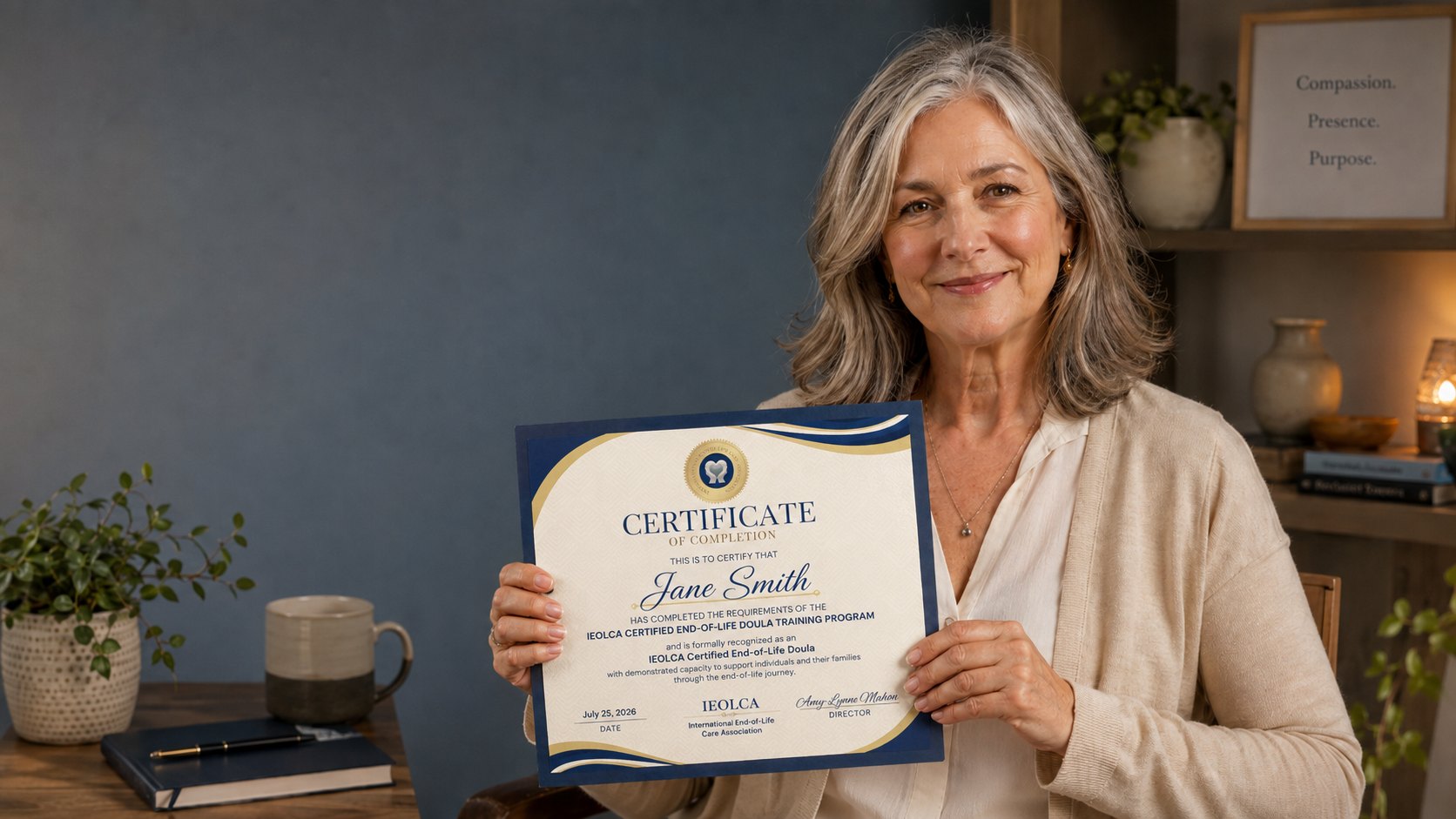
Certification Is Recognition From a Particular Organization
A “Certified End-of-Life Doula” is generally someone who completed the curriculum, assessment, ethics, and other requirements established by a specific certifying organization.
The phrase does not have one universal legal meaning. Different providers may use the word certified for very different standards, from attendance-only courses to programs with assignments, assessment, competency requirements, or ethical commitments.
The organization behind the credential matters. A useful certificate should make the curriculum, completion requirements, scope, and limits reasonably clear.
What a Thoughtful Certification Can Represent
Structured education
The graduate completed a defined learning pathway rather than relying only on informal experience.
Completion requirements
The organization required stated coursework, assessment, reflection, case work, or another completion process.
Ethical preparation
The graduate studied consent, privacy, dignity, cultural humility, referral, and boundaries.
Scope awareness
The graduate learned to distinguish non-medical doula support from healthcare, counselling, legal, funeral, and personal-care services.
Certification may also help a graduate describe their training accurately in a professional biography, website, directory profile, community presentation, or introductory conversation.
Certification, Certificate of Completion, and Licensure Are Different
Certificate of completion
Usually confirms that a learner completed a particular course or educational offering.
Provider certification
Recognizes completion of a provider’s stated standards. The meaning depends on the provider’s curriculum and assessment.
Government licence
A legal authorization issued or recognized by a government or regulator for a regulated occupation.
Membership or directory listing
May involve separate fees, standards, review, or renewal and should not be confused with training completion.
What Certification Does Not Mean
- It does not create a healthcare, nursing, counselling, social-work, legal, funeral, or other regulated licence.
- It does not authorize diagnosis, treatment, medication support, personal care, psychotherapy, capacity assessment, or legal advice.
- It does not guarantee employment, clients, referrals, income, insurance acceptance, directory listing, or facility access.
- It does not mean every provider uses equivalent standards.
- It does not make the graduate competent for every population, setting, service, or specialty.
- It does not remove the need for local legal research, insurance, written agreements, referral, consultation, and ongoing learning.
Good certification adds clarity rather than exaggeration. It should help a practitioner describe preparation honestly without implying authority the credential does not create.
How to Evaluate a Death Doula Certification
- Identify the issuer. Who awarded the credential?
- Review the curriculum. What topics and learning outcomes are included?
- Check the completion standard. Is it attendance, assignments, assessment, case work, or demonstrated competencies?
- Read the scope and ethics. Are medical, legal, counselling, personal-care, privacy, consent, and referral boundaries clear?
- Check renewal terms. Does the title expire or require fees, membership, or continuing education?
- Verify claims. Does the provider avoid promises about licensure, employment, acceptance, clients, or income?
- Ask what the credential allows graduates to say. Responsible providers should discourage misleading titles and claims.
What Does “Competency-Based” Mean?
The phrase generally suggests that completion involves more than time spent in a course. It may include assessment of knowledge, judgment, communication, case analysis, ethical reasoning, or practical application.
However, the phrase itself is not enough. Ask which competencies are assessed, how they are assessed, what standard is required, whether feedback is provided, and whether unsuccessful work can be revised.
A competency claim should be supported by a published framework and a meaningful assessment process.
What the IEOLCA Credential Communicates
The IEOLCA End-of-Life Doula Certification recognizes completion of the organization’s stated 35-hour, 27-module program requirements.
The curriculum includes preparation across areas such as:
- scope, ethics, consent, privacy, and boundaries
- compassionate communication and non-directive support
- cultural humility and inclusive care
- grief and bereavement literacy
- ritual, legacy, vigil, and planning support
- collaboration, referral, and professional practice
The credential represents recognition within IEOLCA’s education framework. It does not represent a government-issued professional licence or universal approval by employers, hospices, facilities, insurers, or other organizations.
What About IEOLCA’s Bridge Pathway?
IEOLCA’s Bridge Pathway is a separate option for eligible learners with at least 30 hours of prior end-of-life doula training.
The Bridge Pathway includes:
- 12 preparation guides
- a 60-question assessment
- three case studies
- tuition of $149 USD
The Bridge Pathway should not be confused with the full 35-hour certification program. Eligibility and completion requirements should be reviewed before enrolment.
How to Use the Certified Title Responsibly
A graduate should identify the issuing organization when clarity matters—for example, IEOLCA Certified End-of-Life Doula.
Avoid language that suggests:
- government licensure
- clinical authority
- universal professional recognition
- approval by a hospice, hospital, facility, or regulator
- expertise in every specialty or population
- guaranteed outcomes for clients or families
The title should describe education honestly—not make the credential sound larger than it is.
Questions Families or Organizations May Ask
- Which organization certified you?
- How many hours and modules did the program include?
- What assignments or assessments were required?
- What services do you offer?
- What is outside your scope?
- Do you hold professional liability insurance?
- How do you handle consent, privacy, records, and referrals?
- What additional training or experience is relevant to this service?
A certificate is one part of the answer. Fit, scope, experience, communication, insurance, and service clarity also matter.