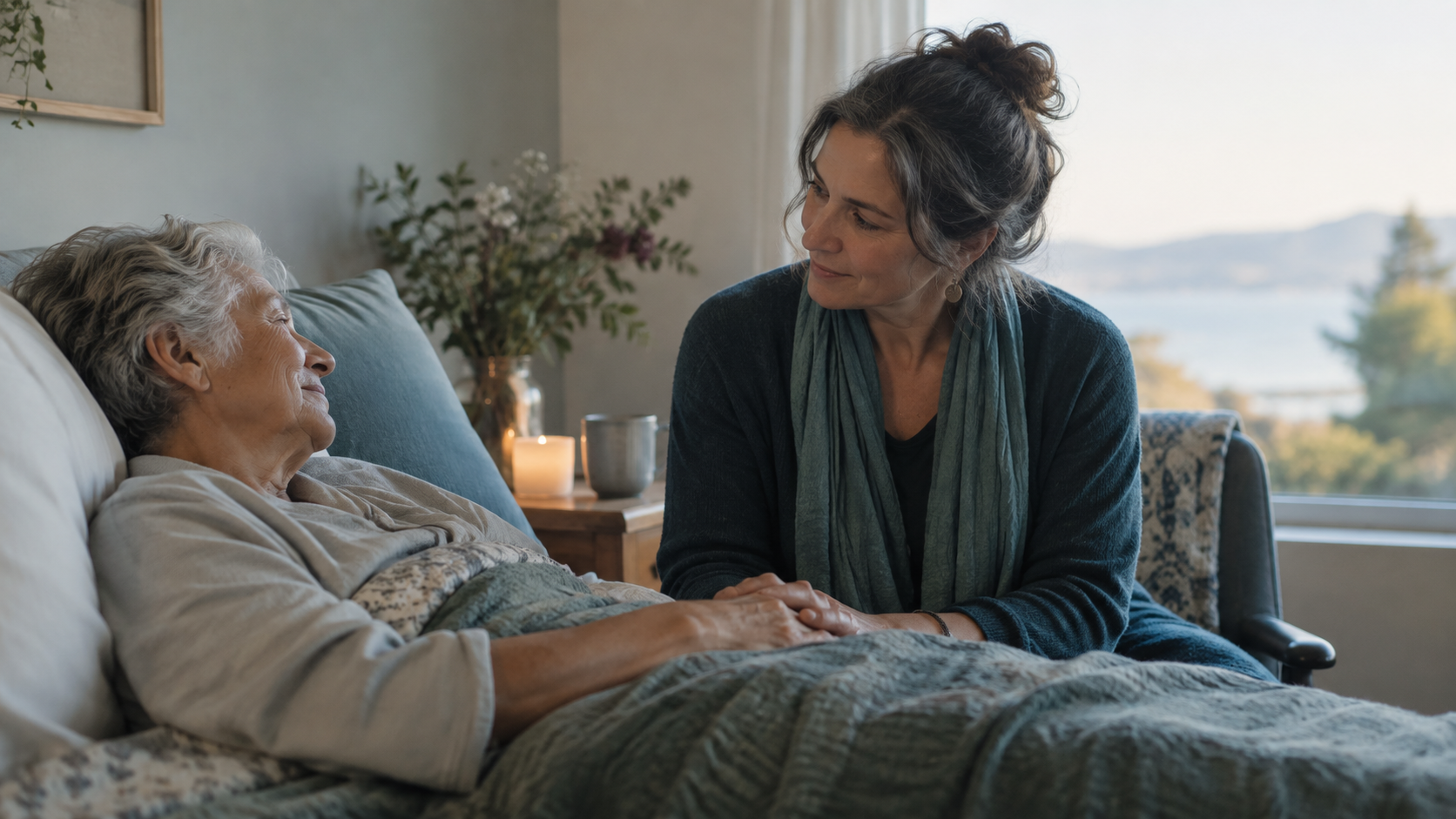
Practical, reflective, accessible end-of-life doula training and certification, founded by Amy-Lynne Mahon and Perry Metheral and grounded in real-world experience, reflective learning, and the Platinum Rule.
The Platinum Rule guides everything we teach:
support people as they wish to be supported.
Our Beginning
IEOLCA began
long before it had a name.
What began as a quiet recognition that caregiving and service had always been part of my life became an international learning community grounded in accessibility, reflection, practical preparation, and respect for each person’s individual path.
Where it began
Long before I knew what an end-of-life doula was, I was often the caregiver and the person others turned to.
Caring for people, being of service, and trying to show up when someone needed support were simply part of how I moved through the world. I didn’t think of those things as a path then. I didn’t have language for them. They were just part of me.
As a student, I volunteered with peers in my school’s special education classes. After my mother experienced a life-changing accident, I helped care for her during her rehabilitation. Later, I supported my grandmother through vascular dementia and raised four children as a single parent. Years later, I adopted Estonia, a ten-year-old rescue dog, and eventually cared for her through her own end-of-life journey.
Looking back, the thread is easy to see.
At the time, though, I was simply living my life.
Following the pull
I began to wonder whether there was a way to offer that part of myself more intentionally.
As my children grew older, I began to feel a pull toward something more. I wanted more direct human connection and more opportunities to support people in the places where life becomes tender, uncertain, and deeply meaningful.
By 2018, that feeling had become difficult to ignore. I valued my work in postgraduate medical education, but much of my role happened behind the scenes. After many years in healthcare and education, I found myself wanting to be closer to people themselves.
Then I learned about end-of-life doulas.
Something clicked.
I began reading, watching, learning, and following the work of people including Sarah Kerr, Henry Fersko-Weiss, and Francesca Arnoldy. What began as curiosity slowly became recognition. There was a name for this kind of work and a way to bring together so much of what had always mattered to me: caregiving, service, presence, learning, and being with people through important transitions.
I began following that thread.
While continuing my career, I completed a Health Care Aide program, with practicums in advanced dementia and end-of-life care. I worked part time in home care, supporting people in their own homes, including people receiving palliative care. In 2023, I began volunteering at Agapé Hospice, and in 2024, I completed end-of-life doula training through INELDA.
Staying close to the work
My hospice service continues today. I have spent time at the bedside with hundreds of dying individuals and their families, and I also help with memorial services, hospice tours, and orientation for new volunteers. Alongside this work, I provide end-of-life doula support pro bono to people in my community.
Presence, care, and human connection are at the heart of this work.
Seeing what could be possible
My own learning helped me understand what I wanted education in this field to offer.
Each experience brought me closer to the work. It also helped me understand what I needed from my own path.
My doula training was a meaningful part of that journey, and it made me think deeply about what education in this field could look like.
I knew people were coming to this work while raising families, working full time, caregiving, managing their own health, or simply trying to understand whether this calling had a place in their lives. I wanted education to make room for those realities.
I imagined training that could be comprehensive without being rigid. Practical and deeply reflective. Accessible without losing depth. Something people could move through at their own pace, return to when they needed it, and carry into whatever form their own work eventually took.
At the end of 2024, I sat down and wrote out everything I hoped my own future in this work might include. I wanted to help normalize conversations about death, support people one-to-one, offer education, remain connected to bedside care, and create something meaningful while respecting my own capacity and limits.
I could describe the life I wanted. I just couldn’t see how all of those pieces could possibly fit together.
The idea takes shape
Sometimes the next step becomes clear when we stop trying to force it.
I spent some time in quiet reflection and decided to set the question down for a while. I was preparing for a visit with my sister in California and trusted that, eventually, the way forward would become clearer.
Instead, the answer was waiting for me when I arrived.
Soon after landing in California, I began telling my sister and her partner about the journey I had been on and all the different ways I imagined this work taking shape.
As we talked, they said something remarkably simple: what if you created an online end-of-life doula training program?
Suddenly, pieces of my life that had seemed separate began to make sense together.
Nearly two decades in postgraduate medical education had taught me about curriculum development, learning objectives, assessment, program evaluation, quality improvement, and the responsibility involved in creating meaningful education. More than three decades in healthcare had shown me how deeply people need compassionate, informed, and respectful support.
And underneath all of it was the same thread that had been there for years: caregiving, service, curiosity about people, and a desire to be useful when life gets hard.
IEOLCA brought those pieces together.
Reflection, learning, and practical tools help learners grow into the work in their own way.
What we wanted to build
Education that helps people learn the work while also discovering who they are within it.
From the beginning, I wanted IEOLCA’s education to be comprehensive, practical, reflective, and genuinely accessible. Learners would be able to study online, at their own pace, from wherever they were in the world. Honor-based tuition would help make the training financially accessible, and lifetime access would allow students to return to the learning as their experience and understanding continued to grow.
But I didn’t want IEOLCA to simply teach people what an end-of-life doula does.
I wanted the learning to help people see themselves in the work.
That meant making space for reflection: exploring our own beliefs about death and dying, recognizing our strengths and boundaries, noticing the assumptions we carry, understanding where our own stories end and another person’s begin, and thinking carefully about the kind of support we are actually being invited to offer.
It also meant creating interactive tools, practical exercises, professional resources, and thoughtful guidance that students could carry forward into real conversations, real relationships, and the work they may eventually choose to do.
For many learners, the journey begins with curiosity or a quiet sense of calling. Through reflection, learning, practice, and experience, that beginning can grow into greater self-awareness, practical understanding, confidence, and a clearer sense of how their own gifts may take shape in service to others.
Most importantly, the Platinum Rule would sit at the heart of everything we taught:
support people as they wish to be supported.
That same respect extends to our students. There is no single way to become an end-of-life doula, and there is no single way to serve once you are one. Some people feel most at home at the bedside or holding vigil. Others are drawn to advance care planning, respite, legacy work, rituals, community education, grief support, or walking alongside families.
Part of this work is discovering where your own gifts meet what your community needs.
As IEOLCA began to take shape, Perry became an important part of building what it would become. His experience in spiritual health, palliative care, mental health, hospice, and whole-person support brought another perspective to the work, particularly around the emotional, spiritual, cultural, and relational dimensions of end-of-life care. Together, we began shaping IEOLCA into the kind of education and community we both wanted to see in the world.
IEOLCA exists to help people explore this work honestly, develop their skills responsibly, and create a path that reflects who they are, what they can offer, and the life they are actually living.
The vision continues to grow, but its heart remains the same:
showing up, being of service, and helping people feel supported through some of the most human moments of their lives.
Founding Leadership
Two perspectives,
one shared purpose.
IEOLCA’s education is shaped by complementary experience in healthcare learning, hospice service, spiritual health, whole-person care, and the realities of supporting people through vulnerable moments.
AM
Amy-Lynne Mahon
Co-Founder, Director & Lead Curriculum Developer
Amy-Lynne brings more than 30 years of healthcare experience, including nearly two decades in postgraduate medical education. Her background includes curriculum development, learning objectives, learner assessment, program evaluation, quality improvement, and standards-based educational operations.
Her Health Care Aide training, home-care experience, end-of-life doula education, ongoing hospice service, and pro bono community doula support help keep IEOLCA’s learning connected to the personal and practical realities of care.
At IEOLCA, she leads educational direction, curriculum development, learner assessment, program documentation, and the personal review of required student assignments.
PM
Perry Metheral
Co-Founder, Co-Director & Curriculum Developer
Perry is a Spiritual Health Practitioner with 20 years of clinical experience across acute care, mental health, palliative care, forensic psychiatry, and hospice settings.
His advanced Clinical Pastoral Education and graduate-level study in leadership inform a compassionate, trauma-informed, person-centered approach to spiritual assessment, grief support, values-based care, interdisciplinary collaboration, education, and mentorship.
At IEOLCA, Perry contributes expertise in the emotional, spiritual, existential, cultural, and relational dimensions of end-of-life care. He also reviews curriculum for whole-person care, inclusion, clear scope, and practical relevance.
Explore IEOLCA Training
Education for the work
you feel called to do.
Begin with our Certified End-of-Life Doula program, explore our popular Pet Death Doula Training, or choose focused education designed for the many ways doulas and care professionals serve.
Education grounded in
respect, humility, and possibility.
These commitments shape how we create programs, support students, and understand the role of an end-of-life doula.
01
Begin with the person
The Platinum Rule asks us to start with the person in front of us: their wishes, values, culture, identity, beliefs, relationships, fears, hopes, and choices.
02
Offer presence without an agenda
We teach compassionate, non-medical, and non-directive support grounded in humility, clear scope, ethical boundaries, and respect for individual autonomy.
03
Make meaningful education accessible
Flexible online learning, honor-based tuition, lifetime access, personal feedback, and respect for different starting points help more people find their place in this work.
How the Work Has Grown
More than a course,
a growing community of care.
IEOLCA continues to grow around the needs of students, graduates, families, and communities. Each part of the work creates another way to learn, connect, contribute, or find meaningful support.
01
Training and certification
Foundational certification, focused programs, and continuing education for varied paths in end-of-life care.
The learning may be online, but
the connection is personal.
IEOLCA now reaches students around the world, but I never want the learning to feel distant. I personally review every required assignment and welcome questions throughout the program.
Your reflections, experiences, hopes, and reasons for coming to this work matter. My hope is that the education gives you knowledge, interactive tools, professional resources, and practical guidance while also giving you space to see yourself more clearly within the work and discover a path that feels honest, sustainable, and genuinely your own.
There is room in this work for many different gifts. We are here to help you recognize yours, develop them responsibly, and carry them forward with care.
Amy-Lynne
Co-Founder and Director, IEOLCA
A Gentle Place to Begin
Wondering whether end-of-life doula work
is right for you?
Explore what draws you to this work, how it may connect with your values, and what your next step could look like.