
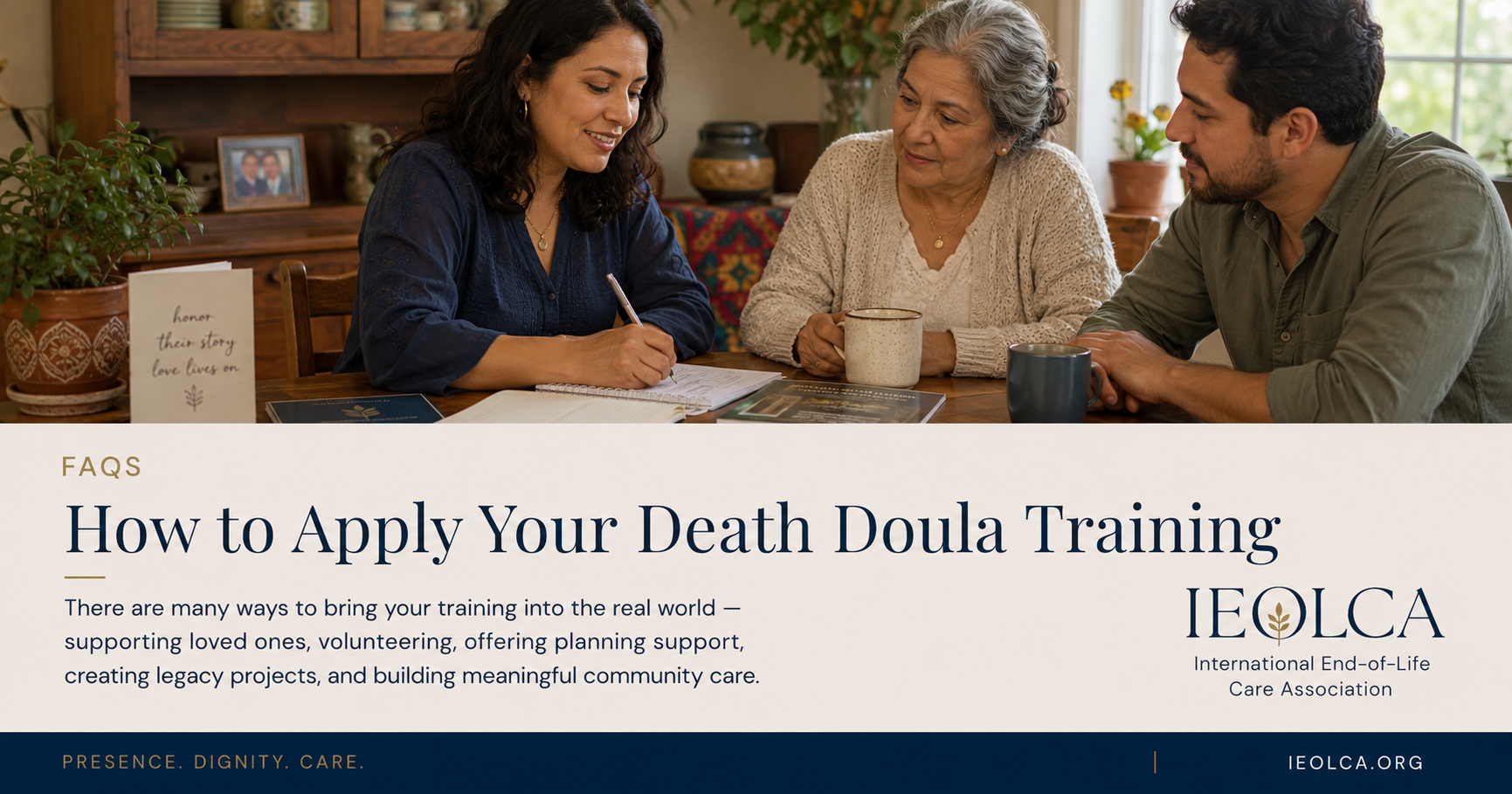
Certification Can Support Many Paths—but It Does Not Create Automatic Employment or Authority
You may use death doula certification to support loved ones, volunteer, educate your community, offer clearly defined non-medical services, bring a doula-informed approach into an existing profession, or continue into specialty education. Certification does not guarantee jobs, clients, referrals, income, facility access, or permission to provide regulated services.
The certificate communicates that you completed a provider’s stated training requirements. What you can responsibly do afterward depends on your actual competence, local rules, service agreement, insurance, supervision or consultation, and the setting where the support takes place.
A death doula certificate is not a medical, nursing, counselling, legal, funeral, or other regulated professional licence.
1. Support Family and Friends More Thoughtfully
Many people complete death doula training without planning to open a business. The education may help them communicate more calmly, ask better questions, understand non-medical support, and remain present during serious illness, dying, grief, or advance care planning conversations.
You may use the learning to:
- listen without rushing to fix or persuade
- help loved ones organize questions for professionals
- support legacy, memory, or life-review projects
- help create a calmer environment
- locate appropriate community resources
- recognize when professional medical, legal, counselling, or spiritual support is needed
Training does not make you the decision-maker for your family. Consent, relationship boundaries, and the person’s wishes still come first.
2. Volunteer Through a Hospice or Community Organization
Hospices, hospitals, care facilities, bereavement programs, faith communities, seniors’ services, and other organizations may offer volunteer roles related to companionship, caregiver support, grief, or end-of-life education.
Death doula certification may be relevant, but organizations may still require:
- their own orientation or volunteer training
- background screening and references
- health or vaccination requirements
- confidentiality agreements
- defined scheduling commitments
- supervision and reporting procedures
- strict limits on private or paid services
Certification does not guarantee acceptance or allow a volunteer to bypass the organization’s policies.
3. Offer Community Education
A certified doula may host educational talks, workshops, discussion groups, death cafés, resource sessions, or public conversations when the purpose and limits are clear.
Possible topics include:
- what death doulas do
- death literacy and common end-of-life questions
- non-medical advance care planning preparation
- legacy and life-review ideas
- caregiver communication and boundaries
- grief-informed community support
Education is not therapy, legal advice, medical instruction, or crisis intervention. Groups need referral plans when acute grief, trauma, abuse, suicidality, or other urgent concerns may arise.
4. Build a Private Death Doula Practice
Some certified doulas offer paid, non-medical services directly to individuals and families.
Services may include:
- planning and values-based conversations
- legacy and life-review support
- vigil preparation and presence
- family communication support
- resource organization and referrals
- grief-informed follow-up within scope
Before accepting clients, consider:
- business registration and local rules
- professional liability insurance
- written service agreements and informed consent
- privacy practices and record keeping
- fees, cancellations, response times, and on-call limits
- referral and consultation relationships
- clear services that match current training and competence
Certification does not guarantee a sustainable practice. Client demand, pricing, expenses, availability, referrals, trust, and local affordability all matter.
5. Add a Doula-Informed Lens to an Existing Profession
Nurses, social workers, counsellors, chaplains, funeral professionals, educators, care workers, volunteers, and other practitioners may use doula education to deepen communication, presence, grief literacy, cultural humility, and family support.
The roles should remain clearly separated. A person working under another profession must continue following the laws, standards, documentation duties, insurance terms, and employer policies attached to that role.
A death doula certificate does not expand the legal scope of another profession.
6. Collaborate With Community and Care Professionals
Doulas may develop relationships with hospices, healthcare providers, funeral professionals, spiritual-care practitioners, counsellors, lawyers, home-care agencies, and community organizations.
Collaboration may include:
- mutual referrals
- community education
- resource-sharing with permission
- participation in meetings when invited and authorized
- defined contracts or programs
A relationship does not automatically make the doula part of a clinical team, create access to private records, guarantee referrals, or permit work inside a facility.
7. Offer Legacy, Vigil, and Planning Support
Many doulas choose a focused service rather than trying to provide every type of support.
A defined offering may centre on:
- legacy letters, recordings, memory boxes, or life stories
- vigil planning and bedside environment
- ritual or ceremony preparation within the person’s beliefs
- family meeting preparation
- non-legal advance care planning reflection
- resource and question organization
Touch, ritual, photography, recording, prayer, and family involvement all require permission. The doula should not impose a preferred idea of a “good death.”
8. Pursue Specialty Education
Foundational certification may lead to further education in areas such as:
- dementia and memory care
- medical aid in dying support
- pediatric or perinatal end-of-life support
- pet loss and companion-animal death
- grief literacy
- home funeral education
- cultural and spiritual care
- business and practice development
A specialty certificate should be understood for what it actually teaches. It does not automatically create licensure, employment eligibility, facility access, or authority beyond the curriculum.
9. Use the Education for Personal Growth
Some learners use death doula training to better understand mortality, grief, family communication, values, planning, and their own relationship with death.
That use is valid even when it never becomes paid or volunteer work. Training may support reflection and education, but it should not be treated as therapy or a substitute for mental-health, grief, medical, or spiritual care.
10. Build Your Path Gradually
You do not need to decide everything immediately after certification.
- Start with your clearest goal. Personal, volunteer, educational, employed, or private-practice pathways require different preparation.
- Choose a narrow first service. Avoid offering more than your current competence supports.
- Confirm local requirements. Review business, privacy, insurance, facility, and service-specific rules.
- Use written agreements. Clearly explain scope, limits, fees, availability, privacy, and referrals.
- Build consultation and support. Identify peers, mentors, supervisors, and professional referral resources.
- Review what is sustainable. Consider travel, emotional load, scheduling, expenses, and other commitments.
What Certification Does Not Automatically Let You Do
A death doula certificate alone does not authorize you to:
- diagnose or treat illness
- provide nursing or personal care
- recommend, prepare, handle, or administer medication
- give legal advice or complete legal documents for someone
- provide psychotherapy or regulated counselling
- determine capacity, eligibility, or informed consent
- guarantee facility access or clinical-team membership
- promise a particular death, family, grief, or business outcome