
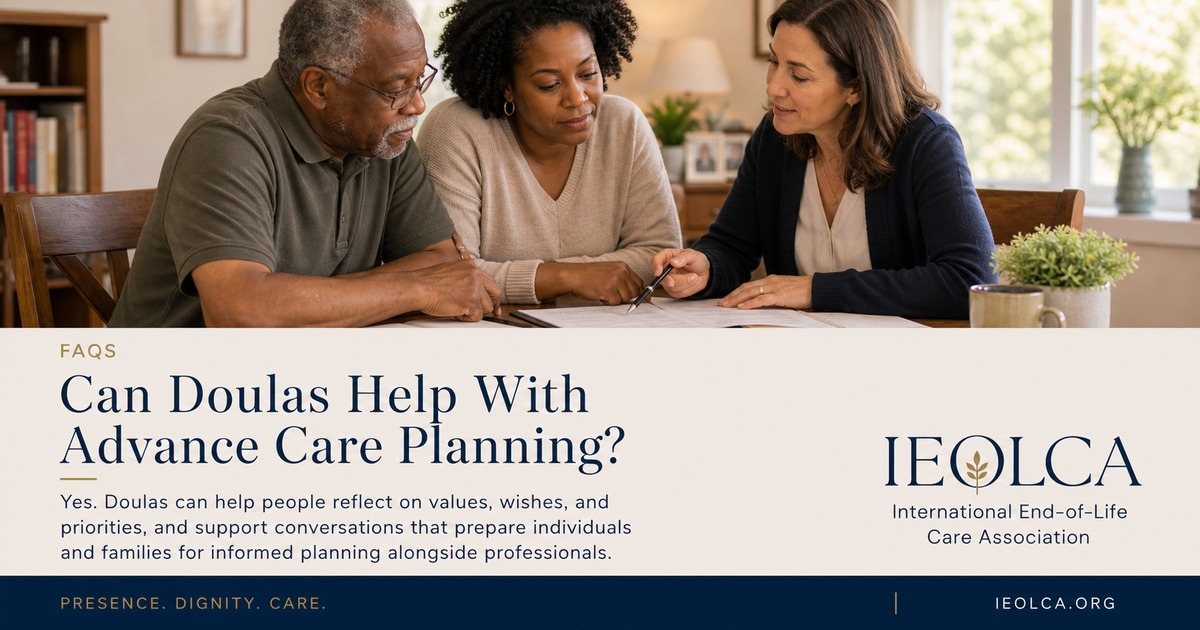
Death Doulas Can Support the Process Without Directing Medical or Legal Decisions
A death doula can help someone identify what matters most, prepare questions, talk with loved ones, organize information, and approach future-care conversations with greater clarity. The doula does not diagnose, recommend treatment, interpret clinical information, provide legal advice, or complete professional documents on the client’s behalf.
Advance care planning is not only paperwork. It is an ongoing process of considering values, life goals, care preferences, trusted decision-makers, and the conversations that may guide future medical decisions if a person becomes seriously ill or cannot communicate.
Roles differ by region and setting. The names, legal effect, witnessing rules, and completion requirements for advance directives vary. Clients should use the forms and professional guidance appropriate to where they live.
What Advance Care Planning Actually Includes
Advance care planning usually begins with conversation and reflection. Written documents may follow, but a form cannot anticipate every future situation. The people involved should understand the person’s values as well as any specific treatment preferences.
Values and priorities
What makes life meaningful? What abilities, relationships, comforts, or spiritual practices matter most?
Future medical decisions
What care or treatments might a person want or decline under particular circumstances?
A trusted decision-maker
Who should speak with the healthcare team if the person cannot communicate their own decisions?
Communication and review
Who needs copies, what conversations should occur, and when should the plan be revisited?
Depending on location, documents may be called an advance directive, living will, healthcare power of attorney, proxy appointment, representation agreement, personal directive, or another regional term. Medical orders such as POLST, MOLST, or similar forms are different from general planning documents and require appropriate clinical involvement.
Planning is relevant before a crisis. Adults of any age can face an illness or accident that affects communication or decision-making. Starting earlier allows more time for reflection and conversation.
How a Death Doula Can Support Advance Care Planning
Make space for values-based reflection
A doula may use open-ended questions to help a person consider comfort, independence, connection, spirituality, place of care, family involvement, fears, hopes, and what an acceptable quality of life means to them.
Help prepare questions for professionals
A doula can help organize questions for physicians, nurses, social workers, lawyers, or other qualified professionals. The doula does not answer clinical or legal questions outside their own credentials.
Support conversations with loved ones
A person’s written wishes are more useful when trusted people understand the values behind them. A doula can help plan a conversation, create a calm setting, keep the discussion person-centred, and identify points that need professional clarification.
Keep information organized
With the client’s permission, a doula may help create a non-clinical planning folder, question list, contact list, or record of topics the client wants to discuss. Privacy, consent, and secure handling of personal information remain essential.
Encourage sharing and regular review
Plans should be shared with the people and healthcare professionals who may need them, stored where they can be found, and reviewed after major health, relationship, location, or preference changes.
Connect the client with appropriate resources
A doula may provide links to reputable regional forms, public education resources, and qualified professionals. Resource sharing should not be represented as legal or medical advice.
Clear Scope Protects the Client and the Doula
Advance care planning includes medical and legal subject matter, which makes role clarity especially important. A death doula’s contribution is generally non-medical, non-legal, person-centred support.
A doula may:
- support values clarification
- help prepare questions
- facilitate respectful conversation
- share general educational resources
- encourage communication with healthcare teams
- help organize non-clinical planning information
A doula should not:
- recommend or discourage medical treatments
- interpret diagnoses, prognosis, or medical options
- select a proxy or make decisions for the client
- draft legal language or determine legal validity
- complete clinician-authorized medical orders
- pressure the client toward the doula’s beliefs
Formal documents belong within the proper regional process. Healthcare providers can explain likely medical decisions and treatment implications. Lawyers or authorized legal resources can advise on legal language and execution requirements.
Can a Death Doula Help With Difficult Family Conversations?
Often, yes—within appropriate limits. A doula may help create structure, slow the conversation down, invite the person whose care is being discussed to speak first, and remind participants that the purpose is to understand that person’s wishes.
The doula should not promise to resolve longstanding conflict or act as a licensed mediator or therapist unless separately qualified to do so. When a conversation involves coercion, abuse, serious conflict, impaired decision-making capacity, or unresolved clinical or legal questions, referral to appropriate professionals is essential.
Helpful communication practices may include:
- asking permission before beginning sensitive topics
- using the person’s own words rather than translating them into clinical conclusions
- distinguishing values from specific treatment decisions
- identifying questions that require a healthcare professional
- summarizing agreements and unresolved questions
- planning when and how the conversation will continue
A Simple Way to Begin
- Start with what matters most. Consider the relationships, abilities, comforts, beliefs, and daily experiences that make life meaningful.
- Choose a trusted decision-maker where local law allows. Ask whether the person is willing and discuss values before a crisis.
- Talk with the healthcare team. Ask about health conditions, likely decisions, benefits and burdens of treatments, and medically appropriate planning documents.
- Use the correct regional forms. Follow applicable signing, witnessing, notarization, registration, and clinical requirements.
- Share the plan. Give current copies to the relevant decision-maker, loved ones, healthcare providers, and any registry used in the region.
- Review it regularly. Revisit the plan after major life changes and whenever values or preferences change.
A death doula can accompany these steps by supporting reflection and communication, but the plan remains the individual’s own and should be completed with the appropriate medical and legal guidance.