
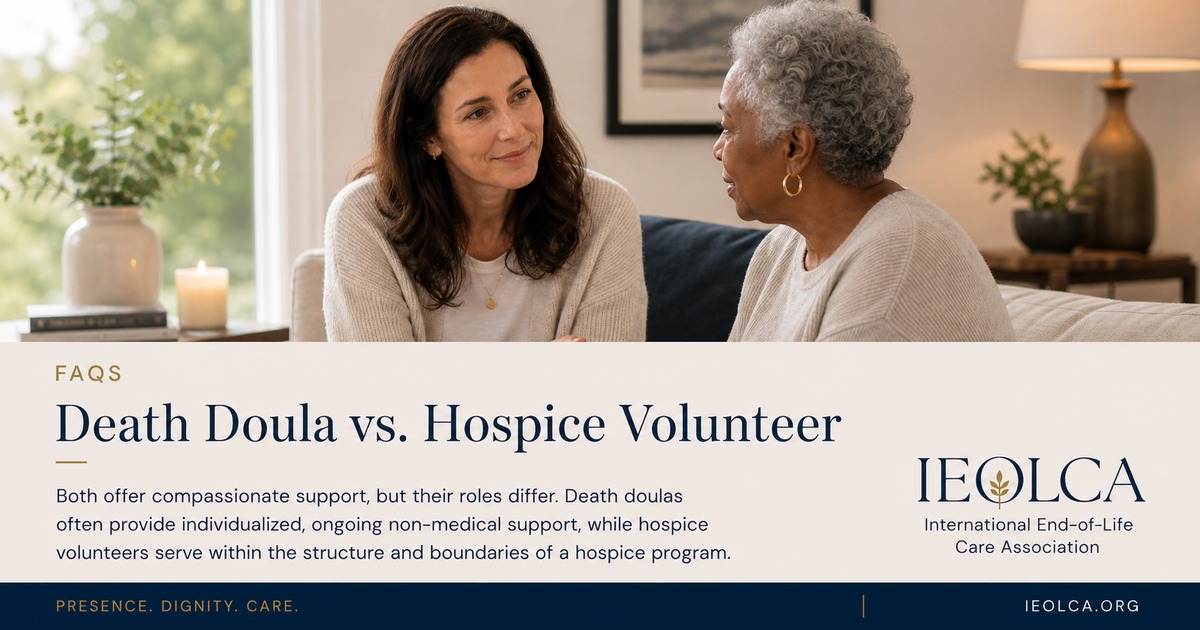
The Roles May Look Similar at the Bedside, but Their Structures Are Different
A death doula is usually an independent non-medical practitioner engaged directly by a person or family. A hospice volunteer serves through a hospice organization and follows that organization’s training, assignments, supervision, care-plan boundaries, documentation expectations, and volunteer policies.
Neither role replaces nurses, physicians, social workers, chaplains, counsellors, personal-support workers, or other licensed and regulated professionals. Both may offer presence, listening, respite, legacy support, practical help, and companionship—but the exact duties depend on the doula’s training and agreement or the hospice’s defined volunteer role.
One role is not automatically “better” or more advanced. Independent practice offers flexibility and responsibility. Hospice volunteering offers organizational structure and supervision. The better fit depends on your goals, experience, boundaries, availability, and preferred way of serving.
What Is a Death Doula?
A death doula—also called an end-of-life doula—is a non-medical support person who may work independently, within a community organization, or through another practice arrangement. Services are agreed directly with the client or family and should be described in a clear written scope and service agreement.
Depending on training and agreement, support may include:
- companionship and calm presence
- values-based reflection and question preparation
- advance care planning conversations within non-medical and non-legal scope
- life review, legacy projects, and memory work
- vigil planning and non-clinical bedside support
- family communication support
- practical organization and community-resource referral
- grief-informed support and follow-up
Independent doulas are responsible for defining their services, staying within competence, obtaining informed consent, protecting privacy, arranging appropriate insurance and business practices, referring outside scope, and avoiding claims their education or credential does not support.
Death doula programs vary. There is no single universal curriculum, training length, examination, credential, or independent-practice standard. Prospective learners should evaluate the actual competencies, ethics, boundaries, assessment process, and support included in each program.
What Is a Hospice Volunteer?
A hospice volunteer serves through a hospice or palliative-care organization without receiving payment for the volunteer role. The organization recruits, screens, trains, assigns, supervises, and supports the volunteer according to its own policies and applicable requirements.
Volunteer opportunities vary widely. Some involve direct patient and family companionship; others focus on reception, fundraising, bereavement programs, transportation, gardening, complementary activities, office support, events, or community outreach.
A direct-service volunteer might:
- visit for companionship and conversation
- sit with a person while a caregiver rests
- read aloud, play permitted music, or share a quiet activity
- assist with approved practical tasks
- support legacy or memory activities within the volunteer role
- report concerns through the assigned coordinator
The volunteer follows the hospice’s boundaries rather than independently expanding the service. The organization determines what training is required, what information the volunteer may receive, whether the volunteer enters the care plan, and how concerns are reported.
Hospice enrollment is not simply a fixed six-month countdown. In systems that use a six-month prognosis standard, eligibility is generally based on the expected course of illness, and a person may remain enrolled longer when they continue to meet the applicable requirements.
Death Doula and Hospice Volunteer: Side-by-Side
Death doula
- usually engaged directly by an individual or family
- may begin before hospice involvement
- often works independently
- defines services through a client agreement
- may charge fees or offer community-supported services
- arranges their own insurance, business systems, and professional support
- is not automatically supervised by a healthcare organization
Hospice volunteer
- serves through a hospice organization
- supports people accepted into that program
- receives organization-specific orientation and role training
- follows assigned duties and organizational policies
- does not receive payment for the volunteer service
- has an identified coordinator or supervisor
- operates within the hospice’s privacy and reporting systems
Where the roles may overlap
Both may offer presence, listening, caregiver respite, legacy activities, culturally respectful support, and practical companionship. The similarity of an activity does not make the accountability structure the same.
Where the roles should remain distinct
A private doula should not present themselves as part of a hospice’s staff or volunteer program unless formally engaged in that role. A hospice volunteer should not market private paid services to assigned patients or families or use confidential volunteer relationships to build a private practice.
Which Path May Fit You Better?
Independent doula practice may fit when you:
- want to build your own defined service
- are comfortable with business and administrative responsibility
- want flexibility in timing and client agreements
- are prepared to arrange consultation, supervision, insurance, and referrals
- want the possibility of professional fees without assuming guaranteed income
- can maintain strong boundaries without organizational oversight
Hospice volunteering may fit when you:
- prefer a structured role with clear policies
- want training connected to a particular organization
- value an assigned coordinator and reporting pathway
- want to serve without running a business
- are comfortable working within assigned duties
- want experience in a supervised volunteer environment
Questions worth asking yourself
- Do I want an independent professional role or an organizational volunteer role?
- How comfortable am I with business, insurance, documentation, and client agreements?
- Do I prefer supervision and assigned responsibilities?
- Am I looking for paid work, volunteer service, or both in clearly separate settings?
- How much uncertainty and scheduling flexibility can I realistically manage?
- What kind of education, mentoring, and practical preparation do I still need?
Can You Be Both a Death Doula and a Hospice Volunteer?
Often, yes—when the hospice accepts the arrangement and the roles remain clearly separated. Volunteering may provide meaningful experience within an organization, while independent doula education may strengthen communication, reflection, and scope awareness.
Before combining the roles, ask the hospice about:
- conflict-of-interest and outside-employment policies
- solicitation and private-referral restrictions
- privacy and use of information learned through volunteering
- social-media and testimonial policies
- gifts, payment, and personal-boundary rules
- whether you may identify yourself as a doula while volunteering
- what to do if a patient or family asks to hire you privately
Never convert a hospice assignment into a private client relationship without explicit organizational guidance. The patient and family should not feel pressured, and confidential access gained through volunteering must not be used for marketing.
How to Get Started
To explore death doula education
- Compare programs carefully. Review competencies, scope, ethics, assessment, instructor support, access, and total cost.
- Clarify your intended role. Decide whether you hope to volunteer, build a private practice, support your own community, or combine several paths.
- Complete education that matches that role. Do not assume a certificate alone creates readiness for every setting.
- Build referral and consultation relationships. Know who can support medical, legal, mental-health, spiritual-care, funeral, and business questions.
- Begin within your competence. Use clear agreements, careful boundaries, and realistic service descriptions.
To explore hospice volunteering
- Contact local hospice organizations. Ask about available roles rather than assuming every hospice uses bedside volunteers.
- Review the commitment. Ask about screening, orientation, scheduling, travel, supervision, and minimum service expectations.
- Complete the organization’s process. This may include an application, interview, references, background screening, health requirements, and role-specific training.
- Use supervision. Report concerns and ask questions through the volunteer coordinator rather than managing difficult situations alone.