
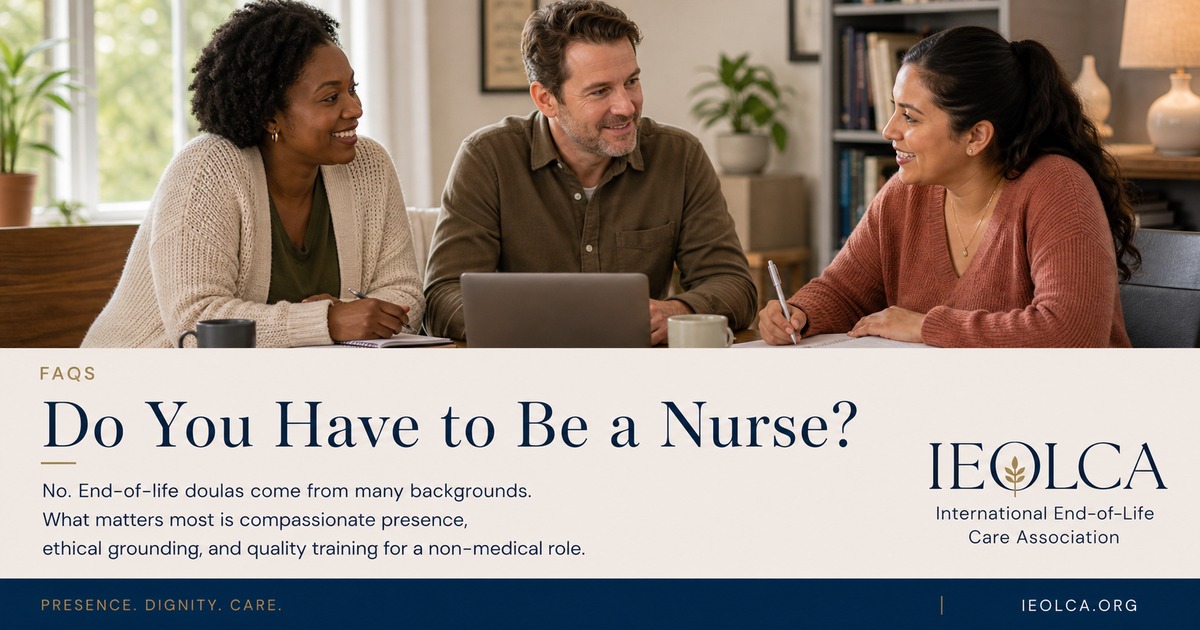
No Nursing Degree Is Required
You do not have to be a nurse—or hold any other medical credential—to train or work within a clearly non-medical death doula role. Death doulas support individuals and families through communication, planning, presence, legacy work, vigils, practical organization, grief awareness, and referral rather than clinical assessment or treatment.
This does not mean that anyone is automatically prepared for independent practice. Responsible doula work still requires education, ethical boundaries, informed consent, privacy, cultural humility, self-awareness, referral relationships, and a clear understanding of what remains outside scope.
Death doula certification is not medical licensure. It does not authorize nursing care, diagnosis, clinical assessment, prescribing, medication administration, wound care, procedures, or any service legally reserved for regulated professionals.
What Death Doulas Do—and Where Their Scope Ends
A death doula may:
- offer calm companionship and emotional support
- help people reflect on values and prepare questions
- support advance care planning conversations within non-medical and non-legal scope
- assist with life review, legacy, ritual, and vigil planning
- support family communication with consent
- help organize practical, non-clinical needs
- connect clients with appropriate professional resources
A death doula should not:
- diagnose or assess medical conditions
- give treatment recommendations
- administer, recommend, or manage medication
- perform nursing procedures or personal care outside competence and authorization
- interpret clinical information as a healthcare professional
- give legal advice or complete legal documents for the client
- represent certification as government licensure
A doula may work alongside nurses, physicians, hospice teams, social workers, chaplains, funeral professionals, and other providers, but is not automatically part of their organization or clinical team.
People Enter Death Doula Work From Many Backgrounds
There is no single “correct” previous career. Learners may come from healthcare, education, caregiving, business, community work, spiritual care, social services, the arts, administration, advocacy, hospitality, or personal experience supporting someone through serious illness or loss.
Healthcare and helping professions
May bring familiarity with communication, grief, systems, privacy, teamwork, or serious illness—but still need doula-specific scope and role clarity.
Education and communication
Teachers, writers, facilitators, and coaches may bring listening, explanation, organization, and group-support skills.
Spiritual and community care
Chaplains, clergy, cultural leaders, and community workers may bring experience with meaning, ritual, belonging, and difficult conversations.
Business and creative fields
Organizational, project-management, artistic, writing, music, and design skills may support legacy work, practice development, and personalized services.
Personal experience is meaningful, but it is not the same as professional preparation. Supporting someone you love may inspire this path while also making education, boundaries, and self-reflection especially important.
Can Nurses Become Death Doulas?
Yes. Nurses may bring valuable clinical knowledge, experience with serious illness, and familiarity with healthcare systems. The challenge is not whether a nurse can do the work—it is whether the person clearly distinguishes the role being provided at a particular moment.
A nurse who also offers doula services should clarify:
- whether they are acting as a licensed nurse, employee, contractor, volunteer, or private doula
- which professional standards and employer policies apply
- whether their liability coverage includes the service
- what documentation is required or prohibited
- which clinical activities are permitted in that setting
- how the client will understand the difference between nursing and doula support
Holding a nursing licence does not automatically turn every private doula service into nursing care. At the same time, a nurse remains accountable to applicable nursing standards when practising nursing.
A clinical background can broaden knowledge, but it does not erase boundaries. In some situations, it makes careful role disclosure even more important.
What Preparation Matters More Than a Nursing Degree?
Scope, ethics, and boundaries
Learners need language for explaining the role, recognizing requests outside competence, referring appropriately, protecting privacy, and avoiding overclaiming.
Communication and non-directiveness
Death doula work requires listening without taking over, respecting the person’s values, and helping clients prepare questions without replacing licensed professionals.
Cultural humility
Practitioners must avoid assuming that every person or family approaches death, religion, disability, grief, decision-making, or family involvement in the same way.
Grief and vigil literacy
Useful preparation includes anticipatory grief, family support, vigil planning, signs that a referral is needed, and understanding the emotional demands of bedside presence.
Practical and professional foundations
Independent practitioners also need informed-consent agreements, privacy practices, realistic service descriptions, insurance, business systems, referral networks, and sustainable boundaries.
IEOLCA’s full End-of-Life Doula Certification Program includes 35 hours of training across 27 modules, with self-paced online study and lifetime access.
Do You Need Experience Before Training?
No prior professional experience is required to begin IEOLCA’s certification program. Experience can still help a learner understand their comfort, motivations, and readiness.
Possible ways to explore the field include:
- hospice volunteering through an organization that provides screening, training, and supervision
- death education, community conversations, and grief-literacy learning
- reflecting on your own relationship with illness, death, uncertainty, and loss
- speaking with practising doulas about workload, boundaries, and business realities
- learning about local healthcare, funeral, legal, and community resources
Do not use friends, relatives, or vulnerable community members as informal “practice clients.” Support naturally when invited, but be honest about your role and current level of preparation.
How Can a Non-Medical Doula Build Professional Trust?
- Describe the role accurately. Use plain language and avoid medical-sounding titles or authority claims.
- Use written agreements. Clarify services, limits, communication, privacy, payment, cancellations, and referrals.
- Stay within competence. Additional training should support actual skill, not simply add badges to marketing.
- Collaborate respectfully. Refer clinical, legal, mental-health, spiritual-care, funeral, and social-service questions appropriately.
- Protect confidentiality. Never use client stories, photographs, testimonials, or identifying details without valid consent.
- Seek consultation and ongoing learning. Independent practice should not mean practising in isolation.
- Avoid guarantees. Do not promise employment, facility acceptance, client outcomes, income, or that certification creates legal authority.
Trust comes from clarity, consistency, humility, and ethical practice—not from pretending to be clinical.
Who May Be a Good Fit for This Work?
A previous profession matters less than how someone approaches learning and responsibility. Helpful qualities include:
- emotional steadiness without emotional detachment
- comfort with silence, uncertainty, and strong feelings
- the ability to listen without fixing or imposing
- respect for different beliefs, families, identities, and traditions
- willingness to receive feedback and recognize limits
- reliable communication and follow-through
- capacity to maintain boundaries, rest, and reflective support
These qualities can be strengthened through education and experience. They are not a substitute for scope awareness, and a certificate is not a substitute for judgment.