
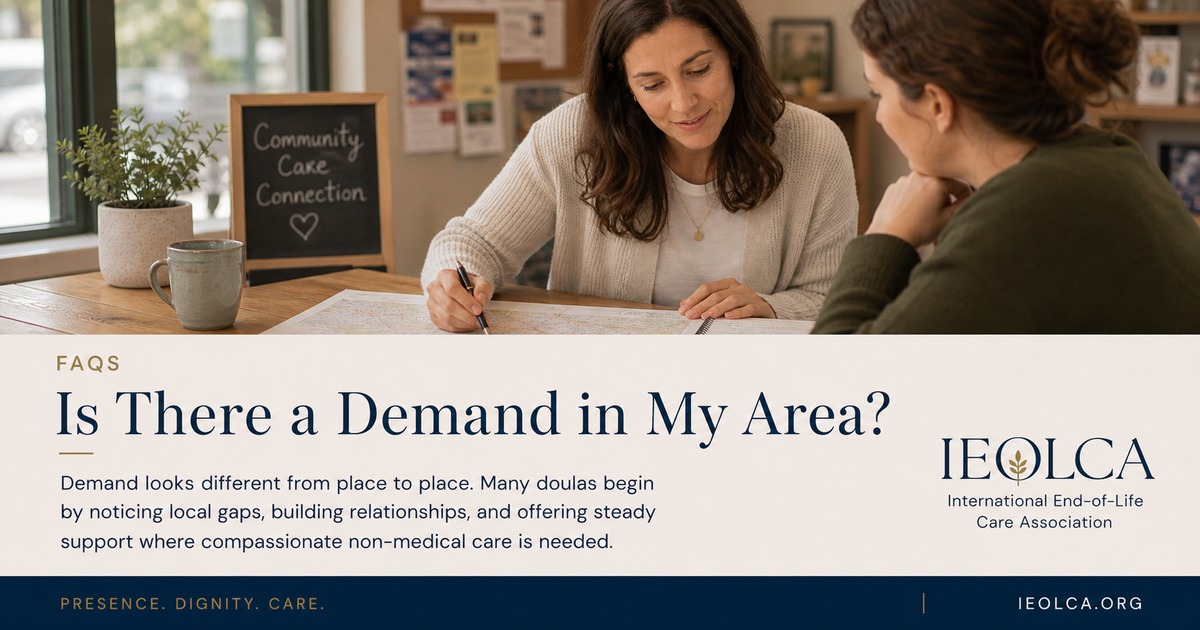
There May Be Need, but Local Demand Must Be Tested
Some communities may benefit from more non-medical end-of-life support, yet that does not guarantee jobs, referrals, clients, or a sustainable private practice. Real demand depends on whether people understand the role, can access or afford it, trust the provider, and see the service as distinct from existing supports.
Broad trends such as population aging, family caregiving, serious illness, and increased public conversation about death may create opportunities for education and support. They do not tell you exactly what people in your town, city, region, or cultural community will use.
Need, demand, and business viability are different. A problem can be real even when no funding or private-payment market exists.
Community Need Is Not the Same as Market Demand
Community need
People may feel overwhelmed, isolated, uncertain, under-informed, or unsupported during serious illness, dying, caregiving, and grief.
Market demand
People know the service exists, understand its value, trust the provider, can access it, and are willing or able to pay—or funding is available.
A community may show strong need but low private demand because of limited income, low awareness, cultural concerns, available family support, public services, or uncertainty about the role.
The reverse can also happen: a smaller group may have strong interest in a clearly defined service such as planning support, vigils, legacy work, dementia-family support, or caregiver education.
What May Signal a Local Need?
Possible signals include repeated reports that families are struggling with:
- understanding what non-medical support is available
- having advance care planning conversations
- family communication and conflict around end-of-life wishes
- caregiver exhaustion and isolation
- legacy, vigil, ritual, or home-environment planning
- culturally or spiritually responsive support
- geographic distance between family members
- aging alone or limited informal support
- finding referrals and community resources
These signals identify questions worth exploring. They do not prove that a particular doula service will be purchased or accepted.
How to Research Death Doula Demand in Your Community
- Map existing services. Review hospices, palliative programs, home care, grief services, funeral providers, spiritual care, caregiver support, social services, and current doulas.
- Listen for repeated gaps. Ask what families struggle to find—not what you hope they need.
- Speak with relevant organizations. Ask about unmet non-medical needs without assuming they want a doula partnership.
- Talk with community members. Use plain language rather than relying on the title “death doula.”
- Study affordability. Consider income, transportation, insurance coverage, public funding, and realistic private-payment capacity.
- Review competition and overlap. Identify what is already offered and where your service would be distinct.
- Track actual behaviour. Inquiries, attendance, referrals, consultations, and repeat requests are stronger signals than social-media interest alone.
Questions to Ask Community Partners
- What non-medical questions do families ask most often?
- Which needs are already being met well?
- Where do families experience delays or confusion?
- Are there language, cultural, geographic, or accessibility gaps?
- What would make an outside provider helpful—or difficult to work with?
- What screening, insurance, privacy, or credential requirements apply?
- Would the organization employ, contract, refer, collaborate, or only provide information?
- What services would duplicate existing staff or volunteer roles?
Do not treat informal interest as a promise of referrals. An organization may appreciate the concept while being unable or unwilling to enter a formal relationship.
What Work Pathways May Exist?
Private practice
Fee-for-service support offered directly to individuals and families, subject to business, insurance, scope, consent, and local requirements.
Volunteer roles
Structured service through a hospice, hospital, care facility, faith community, or agency using that organization’s training and supervision.
Employment or contracts
Possible in some organizations, but titles, duties, credentials, funding, and hiring patterns vary greatly.
Existing professional role
A nurse, social worker, chaplain, educator, counsellor, funeral professional, or other practitioner may add a doula-informed lens while staying within their primary role.
Do not assume a “death doula job market” works like a licensed occupation with standardized titles, salaries, or openings.
Different Communities May Need Different Services
Demand may be shaped by local realities such as:
- urban, rural, remote, or geographically dispersed populations
- language and cultural communities
- religious or spiritual traditions
- availability of hospice, palliative care, home care, and caregiver support
- transportation and digital access
- housing, poverty, disability, and social isolation
- local attitudes toward death, dying, grief, and paid support
A narrowly defined service may be more understandable than a broad promise to “support every end-of-life need.” Clear service descriptions help people decide whether the offering fits.
How to Test the Idea Without Overcommitting
- Offer education before selling. Host a clearly described talk or workshop and measure attendance and questions.
- Use interviews or surveys carefully. Ask about actual experiences, barriers, and willingness to use services.
- Develop one specific offer. Test a planning session, legacy service, caregiver consultation, or workshop instead of launching many services at once.
- Set a defined pilot period. Track inquiries, conversion, time, expenses, emotional load, and referrals.
- Review accessibility. Consider sliding scales, funded partnerships, group formats, or free education without assuming unpaid work is sustainable.
- Adjust based on evidence. Change the service when community response differs from your expectations.
A small pilot can answer more than a large amount of optimistic planning.
What Builds Trust Over Time?
Trust may grow through:
- clear, non-medical scope
- accurate service descriptions
- reliable communication and follow-through
- respect for existing providers and volunteers
- appropriate insurance and agreements
- privacy and consent
- cultural humility and accessibility
- honest referral when needs exceed competence
- community education without fear-based marketing
Trust does not guarantee paid work, but unclear claims can quickly undermine both professional relationships and community confidence.
So, Is Death Doula Work a Good Career Choice?
That depends on what “career” means for you. Some doulas build part-time private practices. Others combine doula work with another profession, volunteer, teach, or use the education personally. Some discover that local private demand is limited.
Before relying on the work for income, evaluate:
- actual inquiries and conversion rates
- local ability and willingness to pay
- time, travel, availability, and emotional capacity
- marketing and relationship-building costs
- insurance, business, and administrative expenses
- competition and service overlap
- whether contracts or funded partnerships are realistically available
IEOLCA does not promise employment, clients, referrals, income, or a particular career outcome.